
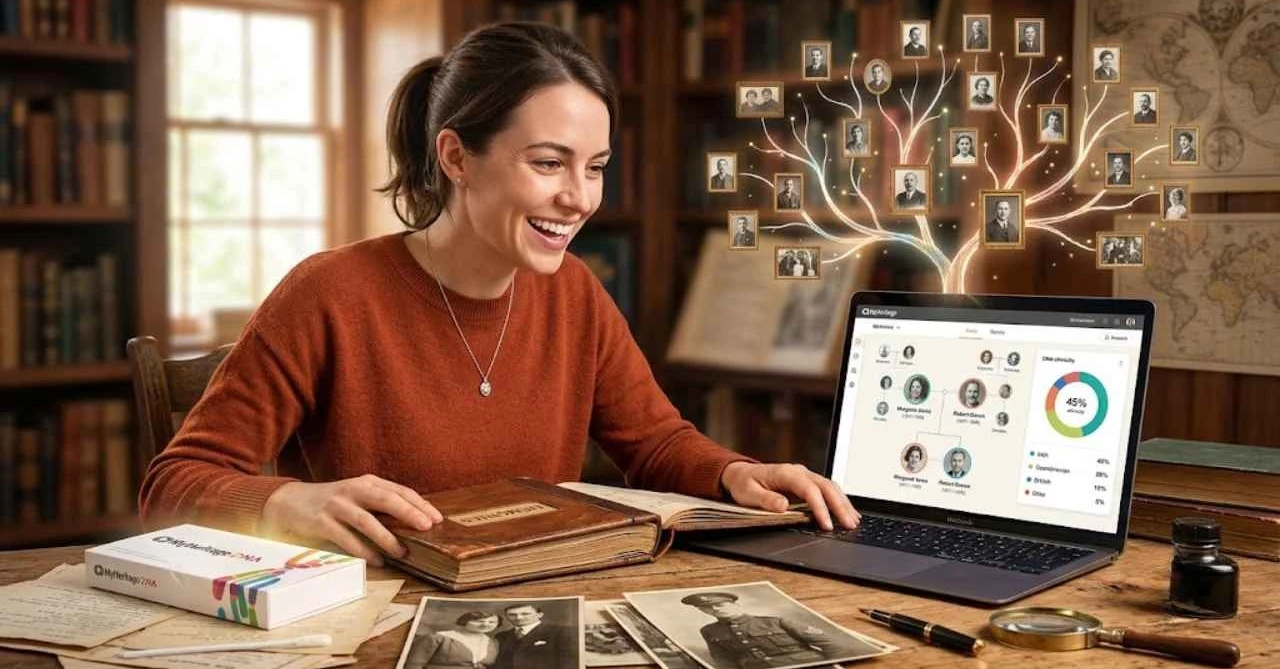
The Complete MyHeritage Guide: Family Trees, DNA, and Historical Records
Discover how MyHeritage can help you trace your roots, connect with relatives, and explore your family history in one powerful platform. This complete guide covers everything from building detailed family trees to taking a MyHeritage DNA test that reveals your ethnic origins across 2,100+ regions. Learn how MyHeritage combines DNA matching, Smart Matches, and access to billions of historical records—such as birth, census, and immigration documents—to uncover hidden connections and fill gaps in your ancestry. Whether you’re a beginner or an experienced genealogist
Table of Contents
ToggleWhat Is MyHeritage?
MyHeritage is a genealogy platform designed to help people discover, organize, and preserve their family history. It combines family-tree tools, historical records, DNA testing, photographs, and matching technologies in one place. This makes it useful whether you are starting with your grandparents’ names or already have generations of research stored in another system. MyHeritage currently advertises access to more than 40 billion historical records, making its database one of the major resources available to family-history researchers. The real appeal is not simply the size of the database, though. Genealogy is like putting together a huge puzzle: one document may reveal a birth date, another may identify a parent, and a DNA match may eventually connect two branches that were separated for generations.
Why Genealogists Use MyHeritage
People use MyHeritage for different reasons. Some want to build a basic family tree, while others are investigating immigration, unknown ancestors, family stories, or distant relatives. The platform’s matching technology can suggest possible connections between your tree and other family trees, as well as potentially relevant historical records. These suggestions can dramatically speed up research, but they should always be treated as research clues rather than proven facts. A matching name does not necessarily represent the correct person, particularly when surnames are common. The best approach is to investigate each suggestion by comparing dates, locations, spouses, parents, occupations, and original documents before adding information to your tree.
Building a MyHeritage Family Tree
Adding Family Information
The smartest way to begin is with information you already know. Add yourself, your parents, grandparents, and other relatives whose details can be confirmed. Include full names, approximate dates, locations, marriages, photographs, and useful notes. If you already have a genealogy tree in another program, MyHeritage also supports GEDCOM imports, making it easier to transfer existing research.
A good family tree should prioritize accuracy over size. It is tempting to add hundreds or thousands of suggested relatives, but an enormous tree filled with unverified information can become difficult to correct. Instead, build outward gradually. Whenever you add an important fact, record where it came from. That habit becomes increasingly valuable as your research moves several generations into the past.
Using Smart Matches and Record Matches

MyHeritage’s matching tools can become some of your most useful research assistants. Smart Matches can identify similarities between your family tree and other trees, while Record Matches can identify historical documents that may correspond to people in your tree. These features can reveal information you might never have found through ordinary searches.
Still, automation should not replace judgment. Another researcher’s family tree can contain mistakes, and those mistakes can spread when people copy information without checking sources. When a match appears, ask whether the person’s age, location, relatives, and life events fit your known family history. If the evidence agrees across several independent sources, your confidence becomes much stronger.
Exploring Historical Records
Historical documents are often the strongest evidence available to genealogists. MyHeritage‘s collections cover many categories, including birth, marriage and death records, census material, immigration documents, military records, newspapers, directories, books, and family trees. Its growing database also includes large collections of digitized newspaper information.
Historical records are valuable because each type can reveal something different. A birth record may identify parents, a marriage record may provide a maiden name, a census can reveal household members, and an immigration record can explain when and where someone moved. A newspaper article might even reveal an occupation, community event, accident, anniversary, or other personal detail that does not appear in official records.
Searching Records Effectively
Do not assume every historical record uses the exact spelling found in your family tree. Names can change through transcription errors, immigration, translation, handwriting, or simple spelling variations. Start with the information you know confidently and then broaden or narrow the search as necessary.
If a search produces no results, try removing one restriction. If you receive too many results, add a location, approximate year, spouse, or another family member. When an original document image is available, inspect it rather than relying entirely on the database transcription. The original may contain information that an index failed to capture.

Understanding MyHeritage DNA
MyHeritage DNA adds genetic evidence to traditional genealogy. Its autosomal DNA test compares genetic markers with other tested individuals and can identify people who share DNA with you. MyHeritage says its DNA results provide two primary categories: an Ethnicity Estimate and DNA Matches.
The current MyHeritage ethnicity model covers 79 ethnicities and analyzes approximately 1.5 million SNP markers. Genetic Groups provide additional geographic detail across more than 2,100 regions. These features can offer fascinating clues, but ethnicity percentages should not be treated as exact proof of nationality or a specific ancestor. They are statistical estimates based on genetic reference populations.
Ethnicity Estimates and Genetic Groups
An Ethnicity Estimate gives percentage-based results, while Genetic Groups provide more detailed geographic associations without assigning percentages. MyHeritage explains that Genetic Groups can highlight places, migration patterns, surnames, and other information associated with particular populations.
This distinction is important. If your result shows a particular ethnicity, it does not necessarily mean that you can identify one specific ancestor from that region. Historical migration and population mixing make ancestry complicated. Genetic Groups can sometimes provide a more focused geographic clue, but they should still be considered alongside documented family history.
DNA Matches and Relatives
DNA Matches can be particularly useful when your paper trail reaches a dead end. A match may connect you to a distant cousin whose family tree contains the missing branch of your own ancestry. MyHeritage says its DNA matching system compares shared genetic sequences and can identify likely family relationships.
The key is to investigate matches systematically. Look for shared surnames, ancestral locations, common relatives, and overlapping family trees. A DNA match becomes much more meaningful when genetic evidence and documentary evidence point toward the same common ancestor.
Combining DNA With Historical Research
The strongest genealogy research combines DNA, documents, and family knowledge. Think of these as three different witnesses describing the same story. Family memories provide clues, historical records provide documentary evidence, and DNA can support or challenge suspected relationships.
For example, suppose you know that a great-grandparent immigrated from a particular region but cannot identify their parents. A passenger record might establish the migration, a marriage record might identify the parents, and DNA matches with descendants of the suspected family could provide additional support. When independent evidence agrees, your conclusion becomes much stronger.
Preserving Family Photos and Memories
Family history should not be reduced to names and dates. Photographs, letters, newspaper clippings, addresses, occupations, and personal stories can transform a family tree into a meaningful historical record.
Whenever possible, identify people in old photographs and record who provided the information. Ask older relatives about places, names, traditions, and stories while those memories are still available. Even a seemingly ordinary photograph can become important when connected to a specific person, location, or historical event.
MyHeritage for Beginners
Beginners should avoid researching every branch at once. Choose one family line and work backward systematically. Start with what you know, identify missing information, search historical records, examine matches, and document the evidence.
Do not measure progress by the number of names you add. A smaller tree supported by reliable evidence is much more valuable than a massive tree containing copied or incorrect information. Genealogy is a long-term project, and careful research today can save you from correcting major mistakes later.
Subscription and Features
MyHeritage offers both free and paid genealogy features, and access can vary depending on the service or subscription. The company currently advertises historical-record access, family-tree tools, DNA services, and other research features. Its current website also promotes DNA and subscription packages, so users should check the official pricing and terms before purchasing or starting a trial.
Rather than subscribing immediately, consider identifying the specific records or features you need first. That makes it easier to decide whether a paid plan provides meaningful value for your research project.


Privacy and Data Protection
Family-history research involves information about living and deceased relatives, photographs, relationships, and potentially sensitive discoveries. DNA information deserves particular consideration because genetic information is personal and permanent.
Before uploading DNA or publishing family information, review MyHeritage‘s current privacy settings and terms. Avoid unnecessarily publishing sensitive information about living relatives. Unexpected DNA results can also reveal family relationships that were previously unknown, so approach discoveries respectfully.
Common Research Mistakes
One of the biggest mistakes is accepting every online family-tree connection as fact. Another is treating an ethnicity percentage as a precise record of ancestry. Researchers can also make errors by relying only on exact name searches or by ignoring spelling variations.
Perhaps the most damaging mistake is adding an unverified ancestor too early. Once an incorrect person enters your tree, automated matching can create dozens of additional suggestions based on that mistake. Always verify important relationships with multiple sources whenever possible.
Best Practices for Genealogy
Good genealogy requires organization and patience. Keep a research log, save important sources, document uncertain relationships, and revisit difficult ancestors periodically. Historical databases continue to expand, so a search that fails today may succeed later.
Most importantly, think like an investigator. Every document should either support a conclusion, challenge it, or create a new question. That approach turns MyHeritage from a simple family-tree website into a powerful research environment.
Conclusion
The MyHeritage guide to family trees, DNA, and historical records ultimately comes down to connecting different types of evidence. Build your tree carefully, use Smart Matches and Record Matches as leads, explore historical documents, and treat DNA results as complementary evidence rather than absolute answers. With its large historical-record collections, 79-ethnicity DNA model, and more than 2,100 Genetic Groups, MyHeritage provides numerous ways to investigate family origins. The most rewarding discoveries happen when technology and careful human research work together. Start with one family line, verify every important connection, preserve the stories behind the names, and let each discovery guide you toward the next generation.
Frequently Asked Question
A. MyHeritage is used to build family trees, search historical records, explore DNA ancestry, discover genetic relatives, and preserve family photos and memories.
A. The current MyHeritage Ethnicity Estimate model identifies 79 ethnicities.
A. Genetic Groups provide geographic ancestry information across more than 2,100 regions, offering additional context beyond percentage-based ethnicity results.
A. Yes, DNA Matches compare shared genetic sequences and can identify people who are likely to be related.
A. No, They are statistical estimates based on comparisons with reference populations. Historical migration and genetic similarities between neighboring populations can affect the results.
Related Post