


Resources
category
6ac56b7ff3164
0
0
1
Loading....
Complete Travel Planning Tips and Insights for LATAM Airlines (US)
Planning your next trip with LATAM Airlines (US)? This guide delivers essential travel planning tips and insights to help you book smarter, pack right, and fly confidently across the Americas. From understanding baggage allowances and fare options to leveraging LATAM Pass miles and Delta partnership benefits, we cover everything U.S. travelers need to know. Learn how to choose the best departure airports, compare round-trip vs. one-way pricing, and time your connections for smoother arrivals in South America. Whether you’re heading to Lima, Santiago, Buenos Aires, or beyond, our LATAM Airlines (US) focused advice ensures you maximize value and minimize stress.
Table of Contents
ToggleIntroduction
Planning an international trip can be exciting, but it also involves many details that are easy to overlook. From choosing the right flight and understanding baggage allowances to checking travel documents and managing connections, every part of your journey can affect your overall experience. For travelers flying between the United States and South America, LATAM Airlines offers an extensive network and several tools designed to help passengers manage their trips. LATAM’s US website provides flight booking, destination information, check-in, baggage guidance, trip management, and other travel services. Whether you are traveling for business, visiting family, taking a vacation, or planning a multi-city South American adventure, careful preparation can make your journey considerably smoother. This guide provides practical LATAM Airlines travel planning tips to help you prepare before booking, organize your luggage, manage airport procedures, and handle connections more confidently.
Understanding LATAM Airlines for US Travelers
LATAM Airlines has an extensive South American network covering destinations in countries including Argentina, Brazil, Bolivia, Chile, Colombia, Ecuador, Paraguay, Peru, and Uruguay. Popular destinations include Buenos Aires, São Paulo, Rio de Janeiro, Santiago, Bogotá, Lima, Cusco, Quito, and Montevideo.
This network makes LATAM Airlines (US) particularly relevant for travelers who want to visit multiple destinations in South America. However, having many route possibilities also means that travelers should examine their complete itinerary instead of focusing only on the departure and arrival cities. Before booking, look carefully at connection cities, flight times, operating carriers, airport changes, and baggage arrangements. A convenient-looking itinerary may involve a long connection or a terminal transfer. Spending a few extra minutes reviewing the complete journey can prevent unnecessary surprises later.
Plan Your LATAM Airlines Trip Carefully
Choose Travel Dates Strategically
Your travel dates can influence airfare, hotel costs, airport congestion, and availability of activities. Instead of selecting dates solely because a flight looks inexpensive, consider the complete cost and purpose of your trip.
If your schedule is flexible, compare different departure dates and flight combinations. Travelers with fixed vacation dates should focus on building a comfortable itinerary rather than squeezing every possible connection into the schedule. International journeys can also be affected by delays, weather, airport congestion, and immigration procedures. Leaving reasonable time between important activities gives you a useful buffer.
Compare Fares Before Booking
A low advertised fare is not necessarily the same as the lowest total travel cost. Different fares can have different baggage, seat, and flexibility conditions. LATAM Airlines (US) recommends passengers review the fare conditions and trip requirements before traveling. Before purchasing, compare:
- Baggage allowance
- Seat options
- Change conditions
- Cancellation conditions
- Flight times
- Connection duration
- Total trip price
This approach helps you choose a fare based on your actual travel needs rather than simply selecting the cheapest number displayed during the initial search.
Booking Your LATAM Airlines Flight

Check Every Reservation Detail
Once you find a suitable flight, carefully review the passenger name, travel dates, airports, flight times, cabin, fare, and connections. Errors are much easier to correct immediately after booking than at the airport.
For international travel, documentation is particularly important. LATAM recommends travelers check applicable requirements involving travel documents, visas, insurance, vaccinations, and other destination-specific requirements before departure.
Keep your reservation code somewhere secure and make sure your contact details are accurate. Having access to your booking confirmation, passport information, hotel details, and onward travel information can be extremely useful if something changes during the trip.
LATAM Airlines Baggage Planning
Understand Carry-On Requirements
Baggage rules are one of the most important parts of LATAM Airlines (US) travel planning. Current LATAM guidance states that a personal item can be included in all fares and has maximum dimensions of 45 × 35 × 20 cm. Depending on the fare, passengers may also have a larger cabin bag with maximum dimensions of 55 × 35 × 25 cm.
The airline also publishes weight limits for cabin baggage. Current guidance lists up to 12 kg in Economy and 16 kg in Premium Economy or Premium Business for the applicable small-bag allowance.
Do not rely on appearance alone when deciding whether your suitcase will fit. Measure your bag, including wheels, handles, and pockets, before leaving home.
Prepare Checked Baggage
If you are checking a suitcase, review the allowance attached to your particular fare and itinerary. Baggage conditions can vary, so it is better to confirm the information in your reservation rather than assuming every LATAM flight has identical rules.
Keep passports, important documents, essential medication, valuables, and critical electronics in your cabin baggage. Your checked suitcase should contain items that can reasonably be replaced if your baggage is delayed.
Packing efficiently also helps. Use a luggage scale before leaving home and avoid filling your suitcase right up to the maximum weight. A small amount of extra capacity can be useful if you purchase souvenirs during your trip.
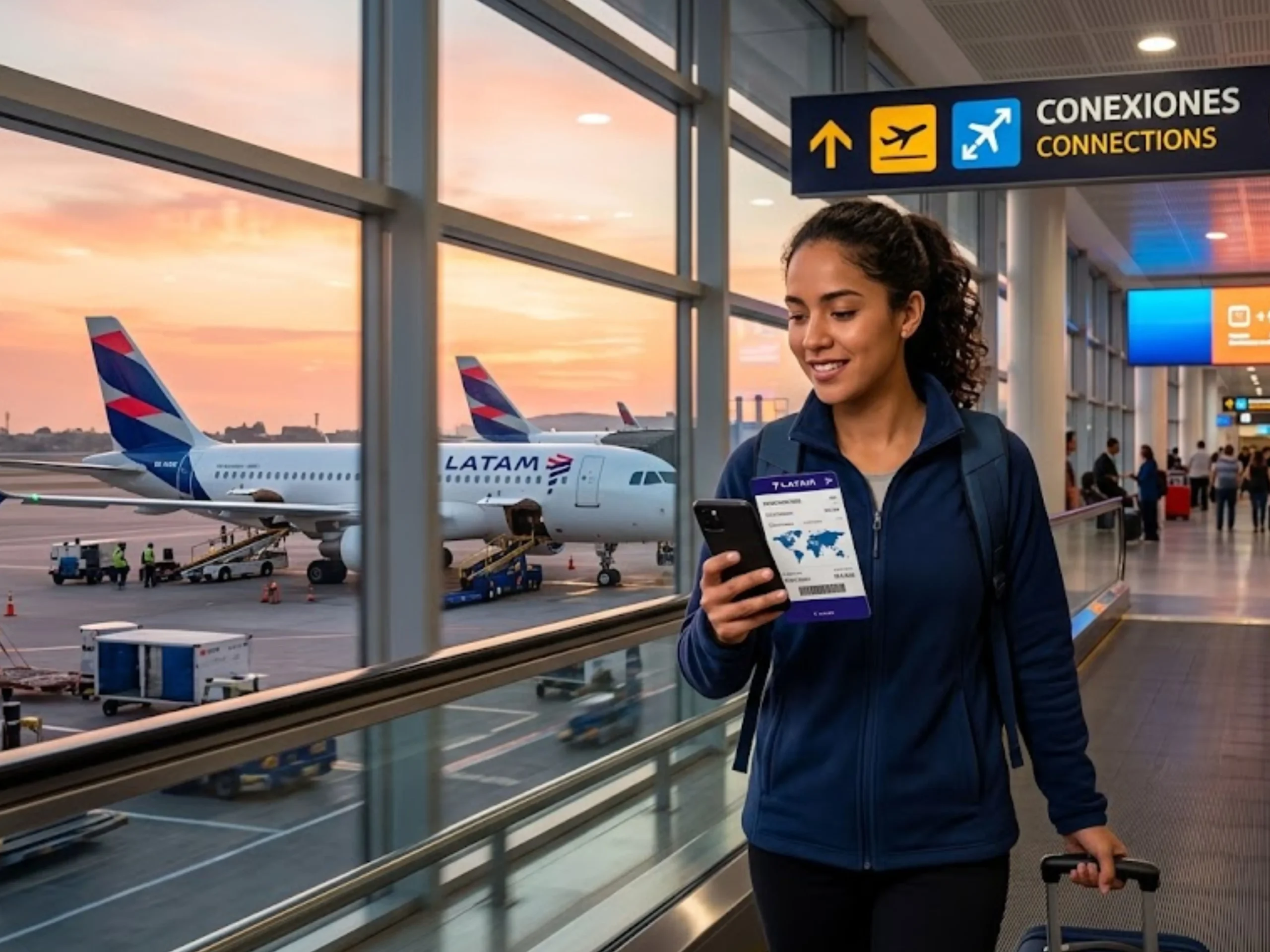
Manage LATAM Airlines Connections
Connections deserve special attention because the amount of time shown between flights does not always tell the complete story. You may need to walk between terminals, pass security or immigration, collect luggage, or complete additional procedures.
For example, LATAM’s information for Santiago Airport explains different procedures for domestic and international connections and identifies separate terminals for those operations.
This is why connection planning should always be based on the actual airport and itinerary. Avoid assuming that a connection that works at one airport will work equally well at another.
If you are traveling with children, elderly passengers, mobility requirements, or several pieces of luggage, additional connection time can make the journey much easier.
Prepare International Travel Documents
For international journeys, your passport is only one part of the documentation checklist. Depending on your citizenship, destination, and transit points, you may need a visa or another travel authorization.
LATAM Airlines (US) advises passengers to check destination-specific documentation requirements before traveling. Make digital copies of important documents and keep them accessible offline. You can also keep hotel reservations, insurance information, emergency contacts, and onward flight details in one secure location. This simple habit can save time when you need information quickly.
Manage LATAM Airlines Connections
Connections deserve special attention because the amount of time shown between flights does not always tell the complete story. You may need to walk between terminals, pass security or immigration, collect luggage, or complete additional procedures. For example, LATAM’s information for Santiago Airport explains different procedures for domestic and international connections and identifies separate terminals for those operations.
This is why connection planning should always be based on the actual airport and itinerary. Avoid assuming that a connection that works at one airport will work equally well at another. If you are traveling with children, elderly passengers, mobility requirements, or several pieces of luggage, additional connection time can make the journey much easier.
Make Your LATAM Airlines Flight More Comfortable
Choose Your Seat Carefully
Seat selection can have a noticeable impact on a long international flight. An aisle seat may be convenient if you like getting up frequently, while a window seat can be useful if you prefer resting against the aircraft wall. LATAM Airlines (US) provides different seating options depending on the route, fare, and aircraft. Its travel-preparation information includes standard and LATAM+ seat options where applicable.
When selecting a seat, consider the length of your flight, whether you are traveling alone or with others, and how much convenience you want during the journey.
Plan Special Assistance in Advance
Passengers requiring special assistance should review LATAM’s requirements before reaching the airport. The airline provides information for travelers with disabilities, medical equipment, service animals, children, babies, and other special travel situations.
Advance preparation is especially important when your itinerary includes multiple airports or international connections. Confirm what services are available and whether additional documentation is required.
Stay Updated Before and During Your Trip
Flight schedules and airport procedures can change. LATAM Airlines (US) provides trip information through channels including email and WhatsApp, and travelers can use its trip-management tools to review relevant information.
Check your reservation periodically before departure rather than relying entirely on the original confirmation. Make sure your phone is charged, your contact details are correct, and your boarding information is easily accessible.
On travel day, monitor airport screens and announcements. Arrive with enough time for check-in, security, immigration, and walking to your gate. LATAM’s boarding guidance emphasizes arriving at the gate with sufficient time because passengers who arrive after boarding has closed may not be accepted.


Conclusion
Successful LATAM Airlines travel planning is mainly about preparation. Start by choosing appropriate dates, comparing complete fare conditions, checking your documentation, and reviewing your baggage allowance. Once booked, monitor your reservation, complete check-in when available, and keep essential documents and valuables with you.
For international trips, connection planning deserves particular attention. Airport layouts, immigration procedures, baggage arrangements, and terminal requirements can vary considerably. Checking the instructions for your specific itinerary before departure is much easier than trying to solve a problem while rushing between flights.
With sensible preparation, travelers can approach their LATAM Airlines journey with greater confidence. The goal is not to predict every possible travel problem; it is to eliminate the avoidable ones before they happen.
Frequently Asked Question
A. LATAM’s current US check-in information states that automatic check-in can be completed 48 hours before departure when applicable. Some international bookings may require additional documentation or confirmation.
A. LATAM currently lists maximum personal-item dimensions of 45 × 35 × 20 cm. Passengers should verify the latest baggage conditions associated with their specific fare and itinerary.
A. A larger cabin bag may be included depending on the fare. LATAM’s current guidance lists maximum dimensions of 55 × 35 × 25 cm for the applicable small-bag allowance.
A. Review passport requirements, visa or travel-authorization requirements, and any destination-specific documentation applicable to your citizenship and itinerary. LATAM recommends checking travel requirements before departure.
A. Review the airport’s terminal layout, connection procedures, baggage requirements, and immigration process before traveling. Allow enough time for the specific airport and itinerary rather than relying on a generic connection-time rule.
Related Post


Top Benefits of Exploring Solar and Battery Solutions from EcoFlow UK
September 28, 2026
Read More »